


Take any exit along former Route 66 in Arizona and you're bound to run into something forsaken and crumbling. The assortment of derelict stone buildings found east of Flagstaff are a perfect example.
As indicated by the sign at Exit 230, they comprise the town of Two Guns — or at least they did. More than once, in fact. Two Guns has been resurrected more times than William Shatner's career. And it's fallen by the wayside more readily every time. It's just one of the reasons the locals insist these acres are cursed.
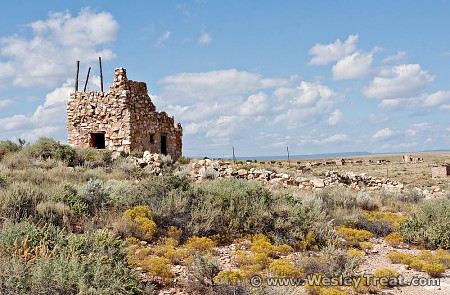
It all started after the bridge that crosses Canyon Diablo was installed in the mid-1910s. Two homesteaders, Earl and Louise Cundiff, moved there in the 1920s and bought out a local prospector who had set up shop along the National Old Trails Highway. The Cundiffs started their own business, opening a large trading post, a free campground and cottages for rent. What's left of their original store continues to crumble today at the south end of the same bridge.
The name Two Guns came from a somewhat eccentric character named Harry "Indian" Miller, a talented huckster who falsely claimed to be a full-blooded Apache named Chief Crazy Thunder. A partner of sorts with Earl Cundiff, Miller signed a lease to do business on the property and assembled a lengthy stone building he dubbed Fort Two Guns. When Cundiff petitioned to open a post office, the name Two Guns was officially rejected in favor of "Canyon Lodge," but Two Guns would prove to be the name that would endure.
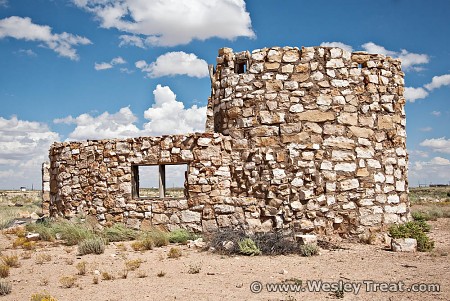
Despite being temporarily stuck with a rather lackluster name, the town went on to achieve years of popularity as a roadside attraction, and its success was due in large part to the efforts of Indian Miller. For one, the extensive complex he called a fort was primarily a wild-animal zoo. Held within its stone and chicken-wire cages were bobcats, coral snakes, porcupines and a variety of other creatures. Miller built the zoo directly along the canyon's precipice and plastered the facade with advertising that brought in plenty of motorists.
Miller also exploited the legend of the nearby Apache Death Cave, launching yet another tourist draw. The cave, located just the other side of the canyon, was the site of a mass execution nearly 50 years earlier. A band of some 40 Apaches had been discovered hiding in the narrow fissure after committing a series of raids and murders against the Navajo. Trapped inside, the Apaches were burned alive for their crimes.
Miller renamed the tomb "Mystery Cave" and erected a series of pueblos and ramps above the entryway. He presented the buildings as ancient cliff dwellings, outfitting the cave itself with more false ruins to complete the illusion. The huckster removed any Apache bones he discovered inside the cave, either selling them or using them as set decoration. He then arranged guided tours, hawking native wares and soft drinks down in the canyon.
Not to anyone's surprise — at least not to those conscious of Miller's myopic "Mystery Cave" endeavor — it was around this time that the legendary curse of Two Guns began to germinate.
For reasons unknown, the Cundiffs decided to lease their store to a pair of drifters who subsequently disappeared in the middle of the night with armloads of merchandise. Worse, Earl Cundiff found himself in a dispute over Miller's contract, an argument which led to Miller shooting Cundiff fatally and in cold blood.
Of course, things didn't end there. Though Miller was inexplicably acquitted of the murder, he went on to suffer his own misfortune. On two separate occasions, he was clawed nearly to death by a mountain lion and a lynx, both residents of his own zoo. He was also bitten on the finger by a Gila monster he kept on display, suffering an infection that swelled his entire arm. Plus, reports indicate Miller lost his daughter around this time in a car wreck, as well as an associate who died under mysterious circumstances.
Not only that, but Miller got himself entailed in a legal battle with Earl Cundiff's widow over property rights. He lost, and by 1930, further circumstances forced Miller to pack up and leave. The reasons for his sudden departure remain unexplained, but they just may have had something to do with the Cundiffs' store being gutted by fire the previous year.
Though Miller was gone, the curse, it seems, persisted. In 1938, Route 66 was rerouted. It had happened once before, but unlike the previous realignment, it was moved to the opposite side of the canyon. Louise Cundiff and her new husband Phillip Hesch were forced to rebuild everything, including the zoo, on the other side just yards away.
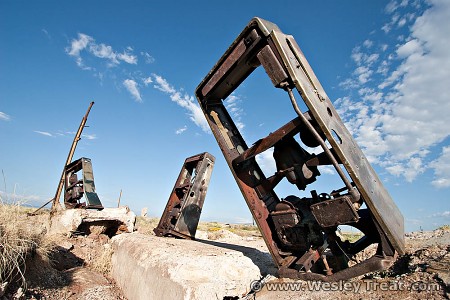
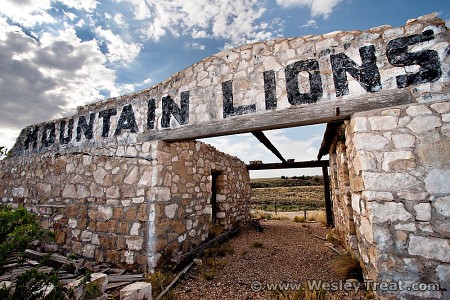
Though still visible from Interstate 40 with its large "Mountain Lions" sign, the new zoo was shut down soon after it opened. It was then sold in 1950 along with the rest of the property. Two Guns then fell under the hands of a series of lessees over the next few years, none of whom appeared to have much more luck keeping the place open.
In the 1960s, the site was sold once again to Ben Dreher, an entrepreneur who appeared to be immune to Two Guns' mojo. Dreher was successful in revitalizing Two Guns by building a new motel, restaurant, gift shop, tavern and service station, as well as instituting a new post office, establishing a county chamber of commerce and reopening the zoo with a reptile exhibit. He cut tourist trails to the old ruins and began exploring the cave in the hope he could someday open a cavern attraction, as well. Finally, it seemed, the curse had been lifted.
Then, in 1971, Dreher's entire complex burned in an explosive inferno. The recently completed Interstate 40 was just about to open and the new Two Guns would have had its own exit ramp.
Further resuscitations have been attempted since, but they've only added to the number of decaying buildings in the ever-expanding ghost town. One simple word, graffitied to the friendly sign near the most recently failed gas station, conveys a simple message that someone, or something, has been trying to tell us all along. 2 GUNS: NOT WELCOME.
1 Comment
My Aunt Elaine was married to Ben when they bought Two Guns. I remember my parents and Grandparents visited there many times. I wish I had some old pictures of when they visited there. My Aunt has since passed and she was divorced from Ben. The money they bought the place with was from an inheritance my Aunt had recieved. I remember hearing many stories about the place.